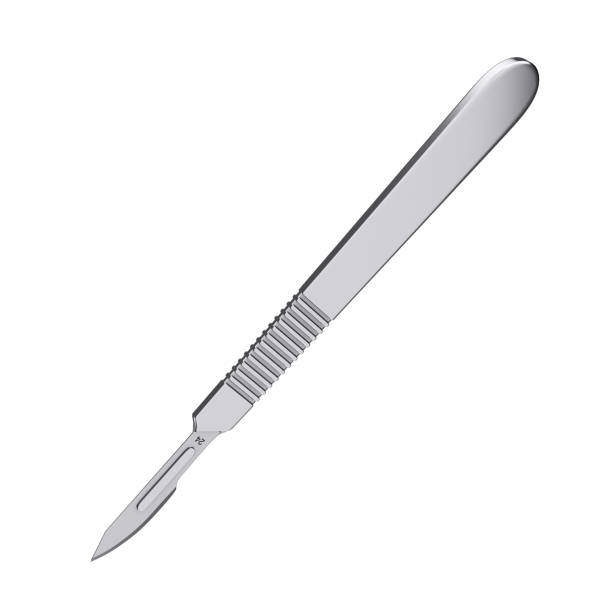
- Scalpel
- Allis Tissue Forceps
- Babcock Forceps
- Mayo Scissors
- Langenbeck Retractor
- Needle Holder (Mayo-Hegar)
- Hemostat (Kelly Forceps)
- Snowden-Pencer Laparoscopic Scissors
- Gynaecological
- Diagnostic Instruments
- Probes and Suction Instruments
- Scalpels and Knives
- Dressing and Tissue Forceps
- Sponge Forceps
- Hemostatic Forceps
- Intestinal and Rectal Instruments
- Orthopedic Instruments
- Retractors
- Cardiovascular Instruments
- Ear Instruments
- Laryngoscopes
- Dermatology
- Sterilization
- Thoracic Instruments
- Neurosurgery
- Urology Instruments
Scalpel
A scalpel is a precision cutting instrument with a sharp blade and a handle, used for making incisions in skin, tissues, or organs during surgery. It is designed for precision and control, minimizing tissue trauma. Scalpels consist of a reusable handle (e.g., Bard-Parker No. 3 or No. 4) and disposable blades that come in various shapes and sizes for specific purposes.
Uses: Used for initial incisions, dissecting tissues, and creating access points in procedures like laparoscopy, orthopedic surgery, or general surgery.
Blades: Common blade sizes include:
- #10: Curved blade for large incisions in skin and muscle (e.g., laparoscopy).
- #11: Pointed tip for stab-like, precise incisions.
- #15: Small, curved blade for fine incisions in delicate tissues.
Handles: Scalpel handles vary in length (e.g., 12–15 cm for No. 3 handle, 14–16 cm for No. 4 handle) and are chosen based on the procedure and surgeon preference.
Material: Stainless steel (handles are reusable; blades are typically disposable).